
Provide reliable and customized solutions to meet the specific needs of industries worldwide
Ferroalloy manufacturer
When buying electrolytic manganese metal (EMM), most buyers first check the manganese content, impurity levels, and price. But there is another question worth considering: should you order flakes or Ingot?
Both forms are used to supply manganese in metallurgical production, but they are not handled in exactly the same way. Their physical shape can affect charging, feeding, storage, and how they behave in the melting process.
So, when comparing manganese metal flakes vs Ingot, the important question is not simply which form is better. It is which one works better with your production process.
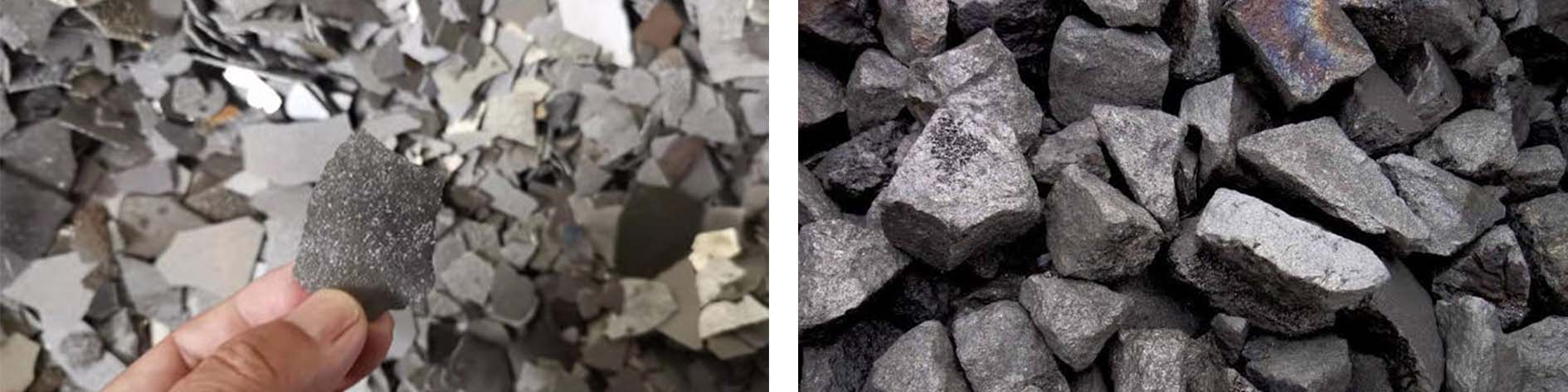
Flakes are the form obtained after manganese is deposited on cathode plates during electrolysis and then removed.
They are typically thin, irregular metallic pieces. Unlike Ingot, flakes do not go through a further compaction process. Their size and shape can vary, depending on production and subsequent screening.
This irregularity is worth considering when handling or feeding the material. Two batches with the same chemical composition may behave differently in a feeding system if their size distributions are significantly different.
Ingot are made by compressing manganese metal material into compact pieces of a more regular shape.
The purpose of this process is to change the physical form, making the material easier to handle in certain applications. However, the final quality depends on factors such as compaction, dimensions, and mechanical strength.
Buyers should also check whether any binders or additives are used. This is important when the chemical composition of the material added to the furnace needs to be carefully controlled.
One common assumption is that flakes always dissolve faster because they are thinner, while Ingot dissolve more slowly because they are denser. The actual situation is more complicated.
Flakes generally have a larger exposed surface area relative to their mass. This can help heat transfer and interaction with the molten metal.
Ingot have a more compact structure and less external surface area per unit mass. However, this does not automatically mean they perform poorly during melting.
What matters is how the material is added. Melt temperature, stirring, immersion, and addition timing all influence dissolution.
For example, small pieces added to a molten bath may remain on the surface if they are not properly submerged. Larger compact pieces may behave differently depending on their dimensions and the movement of the molten metal.
In other words, physical form is only one part of the equation. Actual melting conditions matter just as much.
For many buyers, the biggest difference between flakes and Ingot appears before the material even enters the furnace.
Flakes have irregular shapes and can contain smaller particles. During handling and transportation, friction may also generate additional fines. Depending on the equipment, this can affect how consistently the material flows through hoppers or feeding channels.
Ingot have more uniform shapes, which may make them easier to handle in systems designed for compact pieces. Their dimensions and individual weights can also make certain feeding operations more predictable.
However, Ingot are not automatically suitable for every feeding system. If they are too large, inconsistent, or easily broken, they can create problems of their own.
For manual charging, both forms may work well. The decision often comes down to operator preference, charging procedures, and the amount of material added in each operation.
The choice between manganese metal flakes and Ingot depends mainly on how your plant handles and uses the material.
Flakes may be a suitable choice when your existing process is designed for loose metallic pieces and you have no difficulty with weighing, feeding, or charging them.
Ingot may be worth considering when more uniform piece dimensions are important, particularly in certain mechanical feeding or handling systems.
Before making a decision, consider these questions:
Does your furnace use manual or automated charging?
Does your feeding equipment have specific size requirements?
Is the fines content of the material important to your operation?
Do you need consistent piece weight or dimensions?
Are your storage and transportation conditions likely to affect the material?
Have you compared the actual melting performance of both forms?
If you are considering switching from flakes to Ingot, it is better to test a small quantity first. Compare charging efficiency, dissolution behaviour, and material recovery under the same operating conditions before changing your regular purchasing specification.
Not necessarily. They can originate from the same electrolytic manganese metal material. The main difference is their physical form and the additional processing used to produce Ingot. Always check the chemical composition and confirm whether additives are used.
Not in every situation. Flakes have a larger surface area relative to their mass, but dissolution also depends on melt temperature, stirring, immersion, and material dimensions.
They can be useful in feeding systems that require more uniform material dimensions. However, the briquette size and strength must match the equipment.
For flakes, pay attention to chemical composition, size distribution, and fines content. For Ingot, check chemical composition, dimensions, piece weight, mechanical strength, and whether binders or additives are used.
Manganese metal flakes and Ingot serve the same basic purpose, but their physical differences can affect how they are handled and used.
Flakes retain their irregular shape after electrolysis, while Ingot are compressed into more uniform pieces. Neither is automatically the better option.
The right choice depends on your furnace, charging method, feeding equipment, and operating conditions. Before changing product forms, compare their performance in your own production process rather than relying on general assumptions.